| Quick answer: Many cases settle within about 3 to 18 months. More complex car accident claims in Alabama, especially those involving serious injuries, disputed liability, or litigation, can take one to three years or more. |
Most car accident cases in Alabama resolve through settlement rather than trial, but that doesn’t necessarily mean the process is quick. The timeline can range from a few months to several years, depending on the seriousness of the injuries, how the insurance company responds, and whether fault is being contested.
This guide breaks down each stage of the process, what can cause delays, speed up the process, mistakes to avoid, and how an Alabama car accident lawyer at Caldwell Wenzel and Asthana Personal Injury Lawyers can protect your recovery and claim value.
This article is for informational purposes only and does not constitute legal advice.
What a Car Accident Settlement Timeline Actually Tells You
When people ask how long a car accident settlement takes, they’re usually not thinking about legal timelines. What they really want to know is: when will the bills get paid, when will things feel financially stable again, and how long this whole process is going to hang over them.
Those are valid concerns. The reality is that timing depends on factors that often don’t fully come into focus until the case is already in progress.
In general, cases tend to move faster when fault is clear, injuries are moderate with a defined treatment plan, and the insurance company is cooperative. Delays are more common when liability is disputed, injuries are serious or ongoing, insurers push back, or the available insurance coverage is limited and requires additional claims or litigation.
In Alabama, a more straightforward case might resolve within a few months, while cases involving more serious injuries or disputed fault can take a year or more. If a case proceeds to trial, the timeline can extend further.
This guide walks through each stage of the process, what affects the timing along the way, and how you can help keep your case moving forward.
Most Alabama Car Accident Claims Settle in 3 Months to 3 Years
Car accident settlements in Alabama don’t follow a fixed timeline. How long a case takes usually depends on the type of injuries involved, how clear fault is, and how the insurance company responds.
In more straightforward situations, like minor injuries, clear liability, and a cooperative insurer, a case may resolve within a few months. When treatment lasts longer, or the injuries are more involved, it often takes more time to fully understand the extent of the damages before moving toward settlement. And in cases involving serious injuries, disputed fault, or litigation, the process can stretch out significantly.
One of the most common mistakes people make is accepting the first car accident settlement offer before they have a clear picture of their injuries, recovery timeline, and future medical needs. Once a settlement is accepted and a release is signed, the case is usually closed for good, even if new symptoms, complications, or treatment needs arise later.
Alabama Car Accident Settlement Timeline: Step-by-Step
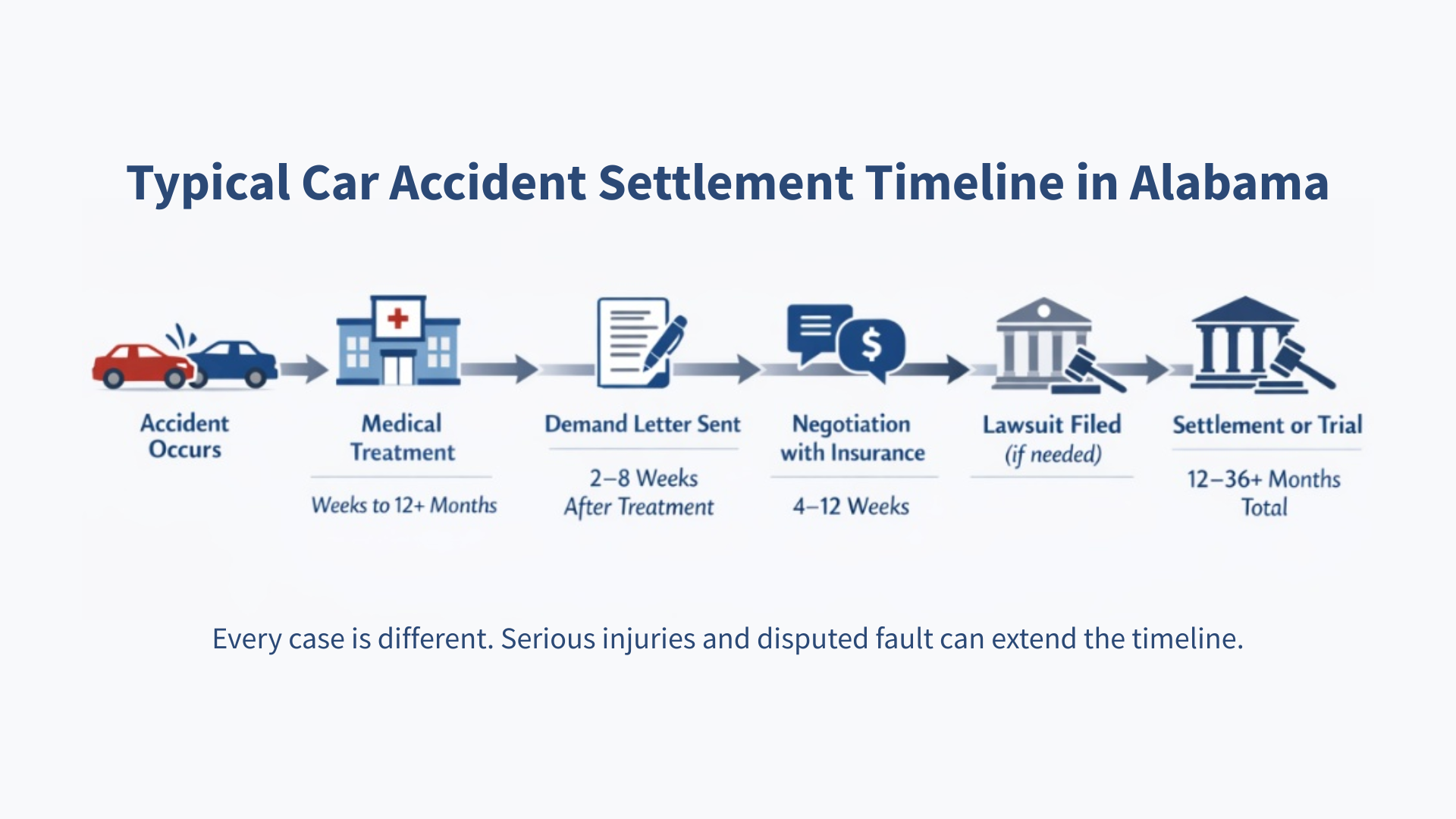
Most car accident claims in Alabama move through several stages before reaching a settlement or trial. Some phases move quickly, while others can take months depending on the severity of the injuries, whether liability is disputed, and how the insurance company responds.
The timeline below breaks down the typical stages of an Alabama car accident settlement and what usually affects how long each phase takes. While timelines can vary significantly depending on the facts of each case, a car accident lawyer at Caldwell Wenzel and Asthana Personal Injury Lawyers can review your situation and give you a realistic estimate of how long your claim may take.
| PHASE | TIMELINE | WHAT DETERMINES IT |
| Medical treatment | Weeks to 12+ months | Injury severity; when maximum medical improvement (MMI) is reached |
| Demand letter sent | 2–8 weeks after MMI | Medical records compiled; attorney review |
| Insurance negotiation | 4–12 weeks | Insurer responsiveness; policy limits; liability dispute |
| Filing suit (if needed) | After negotiation fails | Defendant’s position; Alabama 2-year statute of limitations |
| Discovery & depositions | 6–12 months | Case complexity; number of parties; expert witnesses |
| Trial or final settlement | 12–36 months total | Docket; judge; whether insurer settles before verdict |
Phase 1: Medical Treatment and Maximum Medical Improvement
Experienced personal injury attorneys usually wait until their client has reached what’s known as maximum medical improvement (MMI) before sending a demand. MMI is the point where your condition has stabilized enough for your doctors to give a clearer picture of your long-term outlook and any future care you may need.
That timing matters. Settling too early before that point is reached can mean important factors are left out, like future procedures, continued therapy, ongoing medication, or lasting limits on your ability to work. Once a case is settled, you typically don’t have the option to go back and ask for additional compensation.
What Affects the Length of Medical Treatment After a Car Accident?
Injury severity. A soft tissue injury may resolve in about 6 to 8 weeks. More serious conditions, such as spinal surgery, traumatic brain injury, or major orthopedic repairs, can require 6 to 18 months of treatment before doctors can reliably assess your long-term outlook.
Consistency of treatment. Gaps in care, such as missed appointments or long breaks without a clear medical reason, can give insurance adjusters an opening to argue that your injuries are not serious or were not caused by the accident. Keeping consistent records is important.
Second opinions and specialists. If your primary doctor refers you to a specialist, the process may take longer. That extra time is often necessary to fully understand the injury and is usually worth it in the long run.
Real-World Scenario
Marcus is rear-ended on I-65 near Birmingham and initially appears to have a moderate whiplash injury along with a disc issue in his neck. His treatment starts conservatively with physical therapy and pain management.
Around the third month, imaging shows the condition is not improving, and he is referred to a spine specialist who recommends a procedure. While Marcus wants to resolve the case sooner, he is advised to wait until treatment is completed and his recovery is clearer.
The full course of care takes about 11 months. Because the case was not settled early, the final outcome reflects the full scope of his injury, the treatment required, and its long-term effects.
If Marcus had chosen to settle before going through surgery and completing his recovery, the value of his case likely would have been much lower, and there would have been no way to revisit that decision later.
Phase 2: The Demand Letter
Once you’ve reached maximum medical improvement and your records are complete, your attorney will prepare and send a demand letter to the at-fault driver’s insurance company. This letter outlines how the accident happened, details your injuries and treatment, summarizes your losses, and sets the amount being requested to resolve the claim.
Putting together a strong demand takes time. It requires collecting all medical records and bills, proof of lost income, photos, police reports, and other supporting documents. Sending a demand too early, before everything is fully documented, can lead to a lower valuation of the case.
How Long Does the Insurer Have to Respond?
Under Alabama law, insurance companies are expected to acknowledge claims promptly and respond within a reasonable timeframe. In practice, many respond within about 30 to 60 days, although delays can happen, especially when they believe a case is unlikely to proceed to trial.
If an insurer fails to respond, denies liability without a clear explanation, or makes an offer that does not align with the actual damages, it may indicate that meaningful negotiations are not happening. In that situation, filing a lawsuit may be the next step to move the case forward.
Phase 3: Negotiation
Most cases don’t settle based on the first demand. There is usually some back-and-forth. The insurance company makes an initial offer, your attorney responds, and negotiations continue until both sides either reach an agreement or decide to move forward in a different direction.
How quickly that process moves often comes down to two things.
First is how seriously the insurer takes the possibility of trial. Adjusters tend to respond differently depending on whether they believe a case will actually be litigated if needed. Firms with a track record of going to trial are often approached differently in negotiations than those that typically settle early.
Second is how clearly the case is presented. When liability is well-supported and the medical records and damages are fully documented, it becomes easier for the adjuster to evaluate the claim and justify a reasonable offer. Missing or incomplete information tends to slow things down.
It is also worth keeping in mind that the first offer is rarely the final one. Insurance companies often start low, especially when they believe a claimant may accept quickly. Before responding to any offer, it helps to have a clear understanding of what the case may actually be worth.
Phase 4: Filing a Lawsuit When Negotiation Isn’t Enough
If negotiations break down, whether because the offer is too low, liability is being disputed, or the insurer is not meaningfully engaging, the next step may be to file a lawsuit in the appropriate Alabama court.
Filing a lawsuit does not mean the case will automatically go to trial. In fact, many cases still settle before reaching a courtroom. What it does do is change the pace and structure of the case. It places the matter on a court schedule, requires the insurance company to bring in defense counsel, and starts the discovery process, where both sides must exchange information and evidence.
What is Alabama’s Statute of Limitations?
This is an important point when considering how long to wait to file a car accident lawsuit in Alabama. In Alabama, you generally have two years from the date of the accident to file a personal injury lawsuit. If that deadline passes, you may lose the right to pursue a claim, regardless of how strong the case may be.
While two years can seem like a long time, it often goes by quickly when you factor in medical treatment, negotiations, and gathering the necessary documentation. If a case is getting close to that deadline and has not been resolved, filing a lawsuit may be necessary to preserve your rights, even if the goal is still to settle.
There are also shorter deadlines in certain situations. If the accident involved a vehicle owned by a city, county, or other government entity, the notice requirements can be much tighter, sometimes as short as six months. Those cases need to be addressed as early as possible.
Phase 5: Discovery, Depositions, and Pre-Trial
After a lawsuit is filed, the case moves into what’s known as the discovery phase. During this stage, both sides exchange information, respond to written questions under oath, and give sworn testimony through depositions.
Discovery is often the longest part of the process. It can involve gathering medical records, working with expert witnesses, taking testimony from treating doctors, and, in some cases, bringing in specialists like accident reconstruction experts.
Many cases resolve during or shortly after this stage, once both sides have a clearer understanding of the evidence and the strengths of each position. Some even settle right before trial or while the trial is already underway.
What Happens if the Case Goes All the Way to Trial?
In Alabama, personal injury trials are usually completed within a few days, often lasting around three to seven days. Getting to that point, however, can take much longer. From the time a lawsuit is filed to a final decision, the process often spans one to three years, depending on the court’s schedule and how complex the case is.
While most clients prefer to resolve their case without going to trial, there are situations where it becomes necessary to pursue a fair outcome. The possibility of a trial can also influence how a case is handled along the way, especially when both sides are evaluating their options.

Factors That Can Affect Alabama Car Accident Settlement Timelines
Several Alabama-specific laws and insurance issues can directly affect how long a car accident claim takes to settle. In some cases, they can also affect whether compensation is available at all.
Contributory Negligence
Alabama follows a strict contributory negligence rule. If the insurance company can show that you were even slightly at fault for the accident, it can prevent you from recovering compensation.
Because of that, insurers often look closely for anything that could suggest shared responsibility. They may review your statements, driving history, and the accident report for details that support that argument. When fault is disputed in this way, cases tend to take longer and require a more careful approach to resolve.
Alabama’s Uninsured Motorist Landscape
Alabama has a relatively high number of uninsured drivers, which can add another layer to a case. When the at-fault driver does not have enough coverage, you may need to pursue a claim through your own uninsured or underinsured motorist policy.
Even though it’s your own insurer, these claims are often handled much like any other. The company may still review the claim closely, question aspects of it, and start with a lower initial offer.
Insurance Company Delay Tactics
Alabama law requires insurance companies to handle claims in a timely and good-faith manner, but in practice, timing can vary. Delays are not uncommon, especially when an insurer believes the person handling the claim may be under financial pressure or nearing policy limits.
These delays can show up in different ways, such as repeated requests for additional documents, changes in adjusters, low initial offers, or unclear communication about coverage. Recognizing these patterns early can help in deciding how to respond and whether to take steps that move the case forward more efficiently.
★★★★★
“I got in a car accident in Mobile on Airport Blvd, and it was really stressful dealing with the insurance company. I found Caldwell Wenzel and Asthana on Google and gave them a call. They were very nice and explained everything to me. They helped me more than I expected, honestly.” – Candise L.
What Can Delay a Car Accident Settlement in Alabama?
Several factors can slow down how quickly a case is resolved.
If your injuries are still evolving or not fully understood, it often makes sense to wait. Settling before your condition is clear is a final decision, and it can leave out future care or long-term effects.
When fault is disputed in an Alabama car accident, the process can take longer. Resolving those issues usually requires building evidence to challenge the insurer’s position or negotiating around it, which rarely happens quickly.
Cases involving multiple vehicles or parties can also add time, since different insurers and attorneys have to coordinate and respond. If the at-fault driver’s coverage is not enough, pursuing your own UM or UIM policy creates an additional layer of negotiation.
Delays can also come from missing or incomplete documentation. Gaps in medical records, missing bills, or a lack of proof of lost income can lead to back-and-forth that slows things down.
Finally, people handling claims on their own often face longer negotiations. Insurance companies tend to approach those cases differently, which can affect both the timeline and the outcome.
What Can Speed Up a Car Accident Settlement in Alabama?
Some factors can help move a case along more efficiently.
If your treatment progresses steadily and reaches a clear stopping point, it allows your attorney to evaluate the full picture and move forward with a demand sooner. Cases also tend to resolve faster when fault is clear, such as in rear-end collisions or situations supported by strong evidence.
Having complete and organized documentation from the start can make a big difference. Consistent treatment, thorough medical records, and clear proof of lost income reduce delays and limit back-and-forth with the insurer.
The way a case is presented also matters. When it is clear that a case is well-prepared and supported by evidence, negotiations tend to move more productively. In some situations, declining an early low offer and continuing to build the case can actually lead to a more efficient resolution, since it signals that the claim is being taken seriously.
We Don’t Let Common Delays Slow Down Your Recovery
If your treatment is ongoing or the insurance company is delaying your case, our car accident lawyers in Alabama can step in early to organize the evidence, handle communication with the insurer, and ensure your claim is presented clearly and efficiently. Contact Caldwell Wenzel and Asthana Personal Injury Lawyers for a free consultation.
Real Examples of Alabama Car Accident Settlement Timelines
Here are two real-world examples of how Alabama car accident settlement timelines can vary.
Real-World Scenario 1
Jennifer is driving on Highway 98 in Baldwin County when another driver runs a red light and crashes into the side of her vehicle. She suffers from a broken wrist along with lower back injuries. Fault is clear, supported by dashcam footage.
She begins treatment right away, is referred to a specialist by the second month, and reaches maximum medical improvement around month five. Her attorney sends a demand shortly after.
Because liability is well-supported and the case is properly documented, the insurance company responds within about a month with a reasonable counter. The case is resolved around month eight, with a settlement that reflects her medical expenses, lost income, and the lasting impact on her wrist.
Real-World Scenario 2
David is injured in a rear-end crash on I-10 near Mobile and later learns he has a herniated disc that requires surgery. The at-fault driver argues that David shares some responsibility, raising a contributory negligence defense, and the insurance company denies the claim.
Before the two-year deadline, David’s attorney files a lawsuit. As the case moves forward and depositions are taken, new evidence comes out that weakens the argument that David was at fault.
With trial becoming a real possibility, the insurer re-evaluates its position, and the case is ultimately resolved around month 26. The settlement reflects the seriousness of the surgery, the recovery process, and the overall impact of the accident. An outcome that likely would not have been reached without litigation.
Settlements and Verdicts Secured by Car Accident Lawyers at Caldwell Wenzel and Asthana Personal Injury Lawyers
In many of the car accident cases handled by our lawyers, clients initially faced early settlement offers that did not reflect the full extent of their injuries, future treatment needs, or long-term impact. After the case was properly developed, the value of the claim often looked very different from the insurance company’s early assessment.
Our client victories highlight an important point we see repeatedly in Alabama car accident cases: early offers are often based on incomplete information, while final settlements and verdicts reflect the full, documented value of the claim once all evidence is known.
Avoid These Mistakes That Reduce Car Accident Claim Value
Several common mistakes after a car accident in Alabama can reduce the value of a settlement. Many of these issues happen early in the claims process, often before a full understanding of injuries, liability, or long-term medical needs is developed.
Insurance companies are trained to look for anything that can limit what they pay. Because of that, small decisions made early in a claim can have a significant impact on settlement value.
- Giving a recorded statement too early: The other driver’s insurance company may contact you quickly after the crash. These statements can be used to challenge fault or minimize injuries. In many cases, you are not required to provide a recorded statement right away, and it is important to understand your position before speaking in detail.
- Social media activity during your case: Posts, photos, or check-ins can be taken out of context and used to argue that your injuries are not serious. Even routine activity can be misinterpreted during a claim evaluation, so limiting social media use is often advisable.
- Gaps in medical treatment or missed appointments: Skipping treatment or failing to follow your doctor’s plan can be used to argue that your injuries were not severe or not related to the accident. Consistent medical care helps support both your recovery and your claim.
- Accepting a settlement too early: Early settlements often do not account for future medical treatment, ongoing symptoms, lost income, or long-term limitations. Once a release is signed, the claim is typically closed permanently, even if your condition worsens later.
Understanding these issues early in the process can help protect the full value of your Alabama car accident claim and prevent avoidable reductions in compensation.
Caldwell Wenzel and Asthana Personal Injury Lawyers Can Help You Decide When to Settle
Don’t let a fast settlement become a small settlement. Understanding how long a car accident settlement takes in Alabama and when it actually makes sense to resolve your case requires more than just waiting for an insurance offer.
Whether you are dealing with ongoing treatment, mounting bills, or pressure to settle quickly, our car accident lawyers are available at three convenient locations in Alabama to provide a free, no-obligation case evaluation:
- Foley: Visit our Foley Injury Office at 901 N McKenzie Street Suite A, Foley, AL 36535. We help Baldwin County clients understand when it makes sense to settle and when waiting can protect the full value of their case.
- Mobile: Our Mobile Car Accident Lawyers are located at 6001 Airport Boulevard, Suite 200A, Mobile, AL 36608. We assist injured victims across the Gulf Coast in evaluating settlement offers and timing decisions.
- Birmingham: Our Birmingham Car Accident Attorneys are located at 4505 Pine Tree Cir #121, Birmingham, AL 35243, and serve clients throughout Jefferson County and Central Alabama. We help ensure your case is fully developed before any final decision is made.
Can’t make it to our offices? We offer virtual consultations and can travel to meet you at home or in the hospital if your injuries make travel difficult.
Frequently Asked Questions
Read answers to common questions about how long car accident settlements take in Alabama. For guidance on your specific case, contact our law firm for a free consultation.
Should I accept the insurance company’s first offer?
Rarely. Initial offers are often made early in the process, before treatment is complete, before all expenses are accounted for, and before the long-term impact of the injury is clear. Because of that, they usually don’t reflect the full value of the case.
Can I speed up my settlement by settling before treatment is complete?
You can, but it’s often a decision you can’t reverse. Once you sign a release, the case is closed. If your condition gets worse, you need additional treatment, or you miss more work later on, you generally won’t be able to pursue anything further. Taking the time to complete treatment and understand the full impact of your injuries is one of the best ways to protect yourself financially.
What if I need money now and can’t wait for a settlement?
You do have options. In some cases, pre-settlement funding can provide an advance based on your expected recovery. Medical lien arrangements may also allow you to continue treatment without paying upfront. Some attorneys can help coordinate these kinds of resources while your case is ongoing. They are not perfect solutions, but they can help bridge the gap while your claim is being resolved.
What if the at-fault driver has no insurance or not enough insurance?
You may be able to make a claim under your own uninsured or underinsured motorist (UM/UIM) coverage. In Alabama, insurers are required to offer this coverage, although drivers can choose to reject it in writing. If you have it, your insurance company can step in to cover your losses up to your policy limits when the at-fault driver does not have enough coverage.
These types of claims follow their own process and often involve negotiations similar to those in a standard injury claim.
Do I need an Alabama car accident attorney, or can I handle this myself?
You can handle minor claims yourself when injuries are limited, costs are low, and fault is clear. But when you are dealing with hospitalization, surgery, ongoing treatment, disputed fault, or missed work, that is typically when you need a car accident lawyer, since the value of the case becomes harder to determine and insurance companies often push back more aggressively.
At that stage, the attorneys at Caldwell Wenzel and Asthana Personal Injury Lawyers can help make sure your injuries, losses, and future medical needs are properly valued during settlement negotiations.
How long do I have to file a car accident lawsuit in Alabama?
In most cases, the Alabama statute of limitations gives you two years from the date of the accident to file a personal injury claim. Shorter deadlines may apply if a government entity is involved. If you’re getting close to that two-year mark and your case hasn’t been resolved, it’s important to act quickly. Missing the deadline can mean losing the ability to bring a claim, no matter how strong the case may be.