

| Quick answer: Usually not. Alabama only allows punitive damages when a driver’s conduct rises to wantonness, malice, or a conscious disregard for others’ safety, not mere carelessness. That standard shows up most in drunk driving, hit-and-run, and extreme reckless driving cases, and it must be proven by clear and convincing evidence. Alabama also caps most awards, except in wrongful death cases, where there is no statutory cap at all. |
A driver gets behind the wheel drunk, races through an intersection, or knowingly puts others in danger. When that decision causes a serious accident, compensation for medical bills and lost wages may not be the only issue.
Alabama law allows punitive damages in certain car accident cases. Unlike compensatory damages, which address your injuries and losses, punitive damages are intended to punish particularly wrongful conduct and discourage similar behavior.
But a serious injury doesn’t automatically justify punitive damages, even when the other driver was clearly at fault.
At Caldwell Wenzel and Asthana Personal Injury Lawyers, our Alabama car accident attorneys evaluate whether the evidence supports an ordinary negligence claim, a wantonness claim, or both. Here’s what the law requires and what punitive damages could mean for your case.
This article is for informational purposes only and does not constitute legal advice.
What Does Alabama Law Actually Require for Punitive Damages?
Alabama Code § 6-11-20 sets the rule: punitive damages require clear and convincing evidence of malice, oppression, wantonness, or fraud, a higher bar than an ordinary claim, which only needs a preponderance of the evidence.
In car accident cases, wantonness is almost always the standard that matters: conduct carried on with a reckless or conscious disregard of others’ rights or safety. The key word is conscious. A driver doesn’t have to intend to hurt anyone; they just have to have known the danger and gone forward anyway.
Speed, impairment, eyewitness accounts, electronic evidence, and what the driver knew before the crash can all affect whether a wantonness claim is appropriate. This is why so many injured drivers turn to our car accident lawyers in Alabama. We can conduct our own investigation and look at the circumstances leading up to the collision closely.
| Alabama Law Note
These terms have specific legal meanings, not their everyday sense. Evaluating a case means matching the facts to the legal definition, not just the feeling that the other driver should have known better. |
What Types of Car Accidents May Qualify for Punitive Damages in Alabama?
Certain driving behaviors are more likely to raise questions about punitive damages, although every claim depends on its facts.
Drunk or Impaired Driving Accidents
Driving under the influence can support a wantonness claim when the evidence establishes a conscious disregard for others’ safety.
Relevant evidence may include blood alcohol concentration (BAC) results, toxicology reports, erratic driving, witness statements, and the driver’s conduct before the crash.
A criminal DUI conviction isn’t necessarily required to establish civil liability for wantonness. Conversely, proof that a driver was impaired doesn’t eliminate the need to establish the legal elements of the claim.
Hit-and-Run Accidents
A driver leaving the scene doesn’t automatically make the collision itself wanton.
However, a hit-and-run accident may involve additional evidence of dangerous conduct, including excessive speed, intoxication, or other actions taken before the crash.
If the responsible driver cannot be identified, uninsured motorist coverage may also become relevant.
Our Alabama car accident lawyers can evaluate the underlying collision separately from the driver’s decision to leave the scene. Both may matter, but they aren’t legally interchangeable.
Street Racing and Extreme Reckless Driving
Street racing, excessive speed combined with other dangerous conduct, or deliberately ignoring an obvious hazard may support a finding of wantonness.
Alabama courts have recognized that speed alone generally isn’t enough, but speeding combined with other circumstances can provide evidence of wanton misconduct.
Distracted Driving in Extreme Circumstances
Not every distracted driving accident qualifies for punitive damages.
However, prolonged or deliberate phone use combined with speeding or other dangerous behavior can change the analysis.
In Tutor v. Sines (2023), the Alabama Supreme Court addressed evidence of a driver intentionally speeding while actively engaging with a mobile phone despite knowing the danger involved.
Commercial Truck Accidents Involving Known Safety Risks
A trucking company may face separate liability questions when it knowingly allows an unsafe vehicle or an unfit driver to operate.
Examples might involve documented safety violations, dangerous maintenance conditions, or decisions to continue using a driver despite known risks.
Punitive damages against a trucking company require a legally supported basis for holding the company responsible. The driver’s misconduct doesn’t automatically establish the company’s punitive liability.
Contributory Negligence and Wantonness: Why the Distinction Matters
Alabama is one of the few states that still follows pure contributory negligence: if you contributed to the accident at all, you can be barred from recovering. But it’s an affirmative defense the insurance company has to prove, not something automatic.
Here’s where it matters most: contributory negligence is not a defense to a properly supported wantonness claim. If the driver who hit you was driving drunk or otherwise acting wantonly, your own small mistake doesn’t block that claim, or the punitive damages that come with it.
| Important Warning
An insurance adjuster’s allegation that you contributed to the accident isn’t a final determination of fault. At Caldwell Wenzel and Asthana Personal Injury Lawyers, we don’t treat those allegations as settled facts. We want to understand what happened before accepting a defense that could affect your recovery. |
| Real-World Example: A Drunk Driving Accident in Baldwin County
Imagine a driver leaving a bar late at night, traveling at an excessive speed, and running a red light in Baldwin County. The collision seriously injures another motorist, and subsequent testing establishes significant alcohol impairment. The injured person’s claim may involve both compensatory damages and punitive damages if the evidence supports the required finding of wantonness. The important question isn’t simply whether the driver was arrested for DUI. It’s whether the available evidence establishes the conscious disregard required under Alabama law. |
Could Your Car Accident Claim Involve Punitive Damages?
You don’t have to determine whether the other driver’s conduct legally qualifies as wantonness before contacting a car accident attorney. Tell us what happened, and we’ll discuss the evidence, the claims that may be available, and the next steps. Your first consultation is free.
Who Can Be Held Responsible for Punitive Damages After a Car Accident?
Punitive damages most commonly arise from the conduct of the person responsible for causing the crash.
However, additional parties may be involved when the accident concerns a commercial vehicle, an employer, or another business.
Under Alabama Code § 6-11-27, employers and principals may face punitive damages for certain misconduct involving their employees or agents when statutory conditions are met.
Those conditions can include knowingly employing an unfit individual, authorizing or ratifying wrongful conduct, or circumstances in which the misconduct benefited the employer.
For example, a trucking company that knowingly continued using a driver with a documented history of dangerous conduct may face questions beyond the driver’s personal liability. Trucking company liability can involve hiring decisions, supervision, maintenance, and other safety practices.
Our attorneys look at the decisions made by the people and businesses involved in the crash, not just the actions of the person behind the wheel. Where the facts support it, that can include examining hiring decisions, supervision, maintenance, and relevant safety records.
★★★★★
“They were wonderful to work with! The team was very kind, knowledgeable, and took the time to answer all of our questions. You never want to need their service, but so comforted to know that they are here should we ever need them again!” – Mary K.
How Much Are Punitive Damages Actually Worth in Alabama?
Punitive damages aren’t calculated the same way as compensation for medical bills, lost income, or pain and suffering. Their purpose is to punish particularly wrongful conduct, and Alabama law limits how much can be awarded in most cases. Understanding how much an Alabama car accident case may be worth also means distinguishing between compensatory and punitive damages.
Under Alabama Code § 6-11-21, punitive damages in most personal injury cases involving physical injuries are capped at the greater of:
- Three times the compensatory damages awarded, or
- $1.5 million, subject to periodic inflation adjustments.
This is higher than the general statutory cap of three times compensatory damages or $500,000, whichever is greater. Both fixed dollar amounts are subject to inflation adjustments, so the applicable limit may differ from the figures written in the statute.
One major exception is wrongful death. Alabama allows only punitive damages in wrongful death actions, and the statutory punitive damages caps do not apply. However, these awards remain subject to judicial review and constitutional limitations.
| Alabama Law Note
These caps adjust every three years for inflation under § 6-11-21(f). Whether the at-fault driver’s insurance covers punitive damages depends on the policy language. Alabama generally doesn’t bar coverage, though some policies exclude it. Even then, the risk of a punitive award often leads insurers to offer larger settlements to resolve the whole claim. |
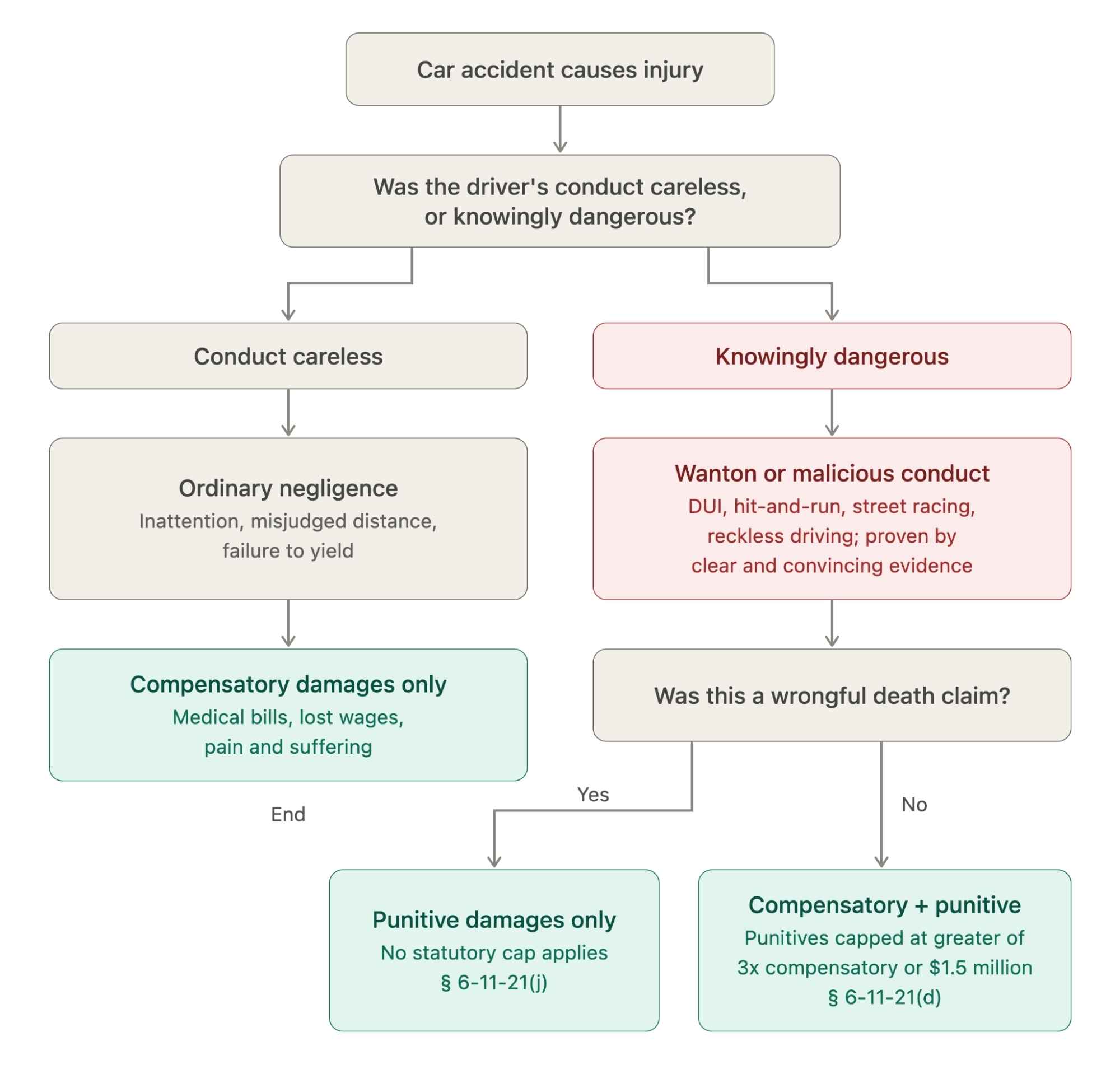
How Alabama sorts a claim into compensatory-only versus compensatory-plus-punitive, and where the statutory cap does and doesn’t apply.
What Can Complicate a Punitive Damages Claim in Alabama?
Even when a driver’s behavior appears particularly reckless, several factors can affect whether punitive damages are available and whether an award can be collected.
Insufficient Evidence of Wantonness
A serious accident doesn’t automatically establish wantonness. For example, a momentary lapse in attention may support an ordinary negligence claim without proving that the driver consciously disregarded a known risk. Alabama requires clear and convincing evidence to award punitive damages in a personal injury action.
Government Immunity
Claims involving government vehicles can raise additional legal barriers. Alabama state agencies generally benefit from sovereign immunity, and Alabama Code § 6-11-26 prohibits punitive damages against the state or its agencies. Claims against individual government employees require a separate analysis, including whether immunity applies to their conduct.
Insurance Coverage Disputes
Even when punitive damages are legally justified, an insurer may dispute whether the applicable policy covers them. Alabama permits certain liability insurance exclusions for punitive damages in personal injury cases, while uninsured motorist coverage follows different rules. The responsible driver’s available assets may also affect whether an award can be collected.
Our attorneys look beyond whether punitive damages are legally possible. We want our clients to understand what their claims may realistically involve, including the strength of the evidence, applicable legal limits, and available sources of recovery.
Alabama-Specific Rules Worth Remembering
Three Alabama rules are particularly important in car accident cases involving potential punitive damages:
- Contributory negligence: A proven contributory negligence defense can defeat an ordinary negligence claim, but not a properly supported wantonness claim.
- Filing deadlines: Most Alabama personal injury lawsuits must be filed within two years of the accident, although exceptions and shorter notice requirements can apply.
- Uninsured motorist coverage: UM/UIM coverage may be relevant when the responsible driver lacks sufficient insurance, and Alabama law treats punitive damages under UM coverage differently from certain liability insurance exclusions.
Our advice is to have the facts reviewed while the relevant evidence is still available. Waiting for a criminal case to conclude or for an insurance company to decide whether a driver acted recklessly can create unnecessary complications for your civil claim.
What Should You Do After an Accident That May Involve Punitive Damages?
When the circumstances suggest drunk driving, extreme recklessness, or another serious safety violation, certain records may become especially important.
- Get medical attention. Seek appropriate treatment and keep documentation of your injuries.
- Obtain the accident report. Preserve the report number and any information about citations, arrests, or suspected impairment.
- Save evidence from the scene. Photographs, witness information, dashcam footage, and nearby surveillance video may help establish what happened.
- Preserve relevant communications. Keep insurance letters, messages, and other records related to the collision.
- Avoid speculating about fault. Be careful about what you say to the insurance company, particularly if you haven’t reviewed the evidence.
- Ask about evidence preservation. An attorney may be able to request relevant electronic records, video footage, or other documentation before it is lost.
- Confirm your legal deadlines. A criminal investigation doesn’t automatically pause the deadline for pursuing a civil injury claim.
Evidence of reckless or wanton conduct can be harder to obtain as time passes, especially when it involves surveillance footage, electronic records, or witness accounts. Taking these steps early can help preserve information that may be critical to proving your claim.
Injured by a Reckless Driver in Alabama? Let’s Discuss Your Case
Some car accidents happen because a driver makes a mistake. Others involve decisions that put everyone on the road at risk. Alabama law recognizes that difference, and so do we.
At Caldwell Wenzel and Asthana Personal Injury Lawyers, your injuries matter, and so does holding the responsible party accountable for what happened. We’ll listen to your story, explain your legal options, and discuss whether the circumstances may support compensatory damages, punitive damages, or both.
From our offices in Mobile, Foley, and Birmingham, our car accident lawyers represent injured people throughout Alabama.
Frequently Asked Questions
Punitive damages involve different standards from ordinary compensation claims. Here are answers to common questions about when they may apply.
Does every drunk driving accident qualify for punitive damages in Alabama?
No. Although impaired driving can support a finding of wantonness, punitive damages aren’t automatic. The evidence must satisfy Alabama’s clear and convincing standard for punitive damages. BAC results, witness statements, the driver’s conduct, and other circumstances can help establish whether that standard is met.
Will punitive damages be paid by the other driver’s insurance?
Possibly. Some Alabama liability policies cover punitive damages, while others contain exclusions applicable to personal injury claims. Uninsured and underinsured motorist coverage is governed by different rules. An attorney can review the applicable insurance policies and explain which damages may be covered.
Can I recover punitive damages if I was partly at fault for the accident?
Potentially, yes. Alabama’s contributory negligence defense doesn’t bar a properly established wantonness claim. However, you still need sufficient evidence of the defendant’s wanton conduct, and the facts of your own actions may remain relevant to other issues in the case.
Are punitive damages available after a hit-and-run accident in Alabama?
They may be, but fleeing the scene doesn’t automatically establish that the driver caused the original collision through wanton misconduct. Evidence of intoxication, dangerous speeding, or other reckless conduct may support a punitive damages claim. If the driver isn’t identified, applicable uninsured motorist coverage may also need to be considered.
Are punitive damages different in an Alabama wrongful death case?
Yes. Alabama wrongful death claims seek punitive damages rather than ordinary compensatory damages, and the statutory punitive damages caps do not apply. These cases have different legal considerations from personal injury claims arising from accidents in which the injured person survives.
How much does it cost to hire a lawyer for a punitive damages claim?
At Caldwell Wenzel and Asthana Personal Injury Lawyers, we handle personal injury claims on a contingency-fee basis. You don’t pay an upfront attorney fee, and our fee arrangement is explained in a written agreement. Separate case expenses may apply under that agreement. Your initial consultation is free.