

$200,000 Recovered for a Premises Liability Fall in Jackson, Alabama
Publish Date : 02 November 2026
Note: We have changed our client’s name in this case study to protect her privacy.
Carla had just come from a funeral when she stopped with her family at a fast food restaurant in Jackson, Alabama. Walking toward the entrance with her granddaughter’s hand in hers, she stepped into a pothole, twisted her ankle, and fell. The restaurant operator later asked the court to throw out the case on summary judgment, arguing the hazard was open and obvious. Attorney C. Randall Caldwell, Jr. represented Carla, and the case settled for $200,000 while that motion was still pending.
 40+ years of combined legal experience
 Free & confidential case evaluations
 Home or hospital visits available
Proven Results
Our Record-Setting Verdicts and Settlements
$10M+
Civil Litigation
Settlement involving civil litigation in Alabama
$10M+
Personal Injury
Settlement involving a workplace injury
$8M+
Medical Malpractice
Jury verdict in medical malpractice against OB/GYN in wrongful death of an infant

A Parking Lot Fall the Restaurant Said Carla Should Have Seen Coming
In February 2023, Carla was walking toward the entrance of a fast food restaurant in Jackson with her family when she stepped into a pothole in the asphalt. She fractured the lower part of her fibula just above the ankle and injured the syndesmosis, the ligament complex that helps stabilize the ankle.
The injury ultimately required two operations. The first repaired the fracture and damaged syndesmosis. Months later, she underwent a second surgery to remove painful hardware and release scarred tendons around the ankle.
The restaurant operator did not simply dispute the amount Carla should recover. It asked the court to end the case before trial, arguing that the pothole was an open and obvious condition that a reasonable customer should have noticed. The defense also separately challenged the claimed connection between the parking lot fall and Carla’s later knee injury.

How the Fall Happened
Carla was walking toward the restaurant with her husband, mother-in-law, and two young grandchildren. She was holding one granddaughter’s hand and looking for the entrance when she stepped into the pothole, twisted her ankle, and fell.
According to Carla’s account, restaurant employees came outside afterward but told her they could not touch her or call 911. A customer directed her husband to a nearby hospital, and he drove her there.
No police report or restaurant incident report was created. Carla later contacted the shift leader herself to report what had happened and obtain insurance information.
Two Ankle Surgeries, Then a Disputed Knee Injury
The fall caused a comminuted Weber C fracture of Carla’s fibula and disruption of the syndesmosis.
In March 2023, she underwent open reduction and internal fixation of the fracture and syndesmosis, followed by a period in a cast and walking boot and an extended course of physical therapy.
In October 2023, she required another surgery to remove hardware that had become painful and to release scarred tendons on the outside of the ankle.
About ten months after the original fall, Carla injured her knee while stepping down a stair. She testified that she did not trip or fall. Imaging and treatment later identified a meniscus tear, a Grade 1 MCL injury, and cartilage damage.
Carla underwent knee arthroscopy in February 2024. Later medical records also documented mild hip tendinosis.
The relationship between the knee injury and the original parking lot fall became one of the central disputes in the case. The defense denied that the two were causally connected. Carla’s medical evidence supported the position that weakness and instability remaining after the ankle injury contributed to the later knee injury.
As of the latest medical record reviewed, dated September 2024, Carla continued to report knee aching, stiffness, and difficulty with stairs. Her doctor noted that a total knee replacement could eventually become a last-resort option, although no formal permanent impairment rating had been assigned.
The Hole Wasn’t the Question. Whether She Should Have Seen It Was
The restaurant operator’s primary liability argument was that the pothole was an open and obvious condition. In other words, the defense argued that a reasonable customer in Carla’s position should have recognized and avoided the danger.
That made the appearance of the pothole critical. If the court accepted the defense’s position and granted summary judgment, Carla’s case could have ended without ever reaching a jury.
Attorney Randall Caldwell explained our firm’s position:
Their argument was that the hole was obvious. Our client’s testimony was that the asphalt around it was the same color as the hole itself, that she was looking for the front door, and that she had a small child by the hand. In Alabama, open and obvious is the property owner’s defense to prove. It is not our burden to prove she could not see it.
The defense separately challenged the knee portion of the case, arguing that an injury occurring months later while Carla was stepping down a stair was too disconnected from the original fall to be included in the claim.
Building the Case Around What the Evidence Could Show
One of the strongest pieces of evidence was created within minutes of the accident.
Before Carla and her husband left for the hospital, her husband took photographs of the pothole on his phone. Those images preserved the size, shape, and appearance of the hazard before there could be any question about whether the parking lot had later been repaired or altered.
Our firm also relied on an aerial image of the parking lot and Carla’s deposition testimony about what she could and could not see as she approached the entrance.
On the disputed knee causation issue, our firm retained a board-certified orthopedic surgeon who was fellowship-trained in sports medicine. After reviewing the treatment record, he concluded that Carla’s original fall caused her ankle injuries and that lingering weakness in the leg and ankle contributed to the later knee injury.
The case received additional support from a treating provider during a July 2025 deposition. Physical therapy records from April and May 2023 documented weakness, instability, and reduced range of motion, and the provider testified about how ankle instability and deconditioning can increase the risk of a later twisting knee injury.
The best witness in this case was a photograph her husband took on his phone in the parking lot before they drove to the hospital. Nobody had to remember what that hole looked like, or argue about whether it had been patched since. It was right there.

C. Randall Caldwell, Jr.
Holding the Case’s Value While Summary Judgment Remained Pending
We internally valued Carla’s case at $200,000 in October 2024. Eleven months later, it settled for exactly $200,000, while the defendant’s fully briefed motion for summary judgment was still awaiting a ruling.
By then, we had photographs showing the condition of the pothole at the time of the accident, medical records documenting two ankle surgeries, an orthopedic causation opinion addressing the later knee injury, and supporting testimony from a treating provider.
Suit had been filed in June 2024. The treating provider’s deposition took place in July 2025. The settlement check was issued in September 2025, and the court entered the dismissal the following day.

The Settlement: $200,000 Gross, $88,311.91 to Carla
Carla’s gross settlement was $200,000.
One of the financial issues our firm also addressed was a health insurance subrogation claim. That claim was initially asserted at $6,586.04, later increased, and eventually reached a peak of $19,333.29.
After our firm challenged items included in the insurer’s reimbursement calculation, the related-claims total was recalculated to $12,078.33. The insurer ultimately agreed to accept $7,247.00 in full and final payment, approximately 40% below the corrected figure and about 63% below the earlier peak.
A total of $23,249.45 in outstanding provider bills was paid from the settlement.
After fees, liens, and other disbursements, Carla received a net recovery of $88,311.91. The settlement check was issued in September 2025, and Carla’s disbursement check was issued in October, about three and a half weeks later.
What This Case Says About Our Approach
This case shows how our premises liability lawyers in Alabama approach a claim when the defense disputes responsibility itself, rather than simply arguing over the amount of compensation:
Preserving the condition immediately
Carla’s husband’s photographs captured the pothole before anyone could repair, patch, or alter it.
Building the liability case around objective evidence
The photographs, aerial imagery, and Carla’s testimony addressed the defense’s argument that the pothole should have been obvious.
Documenting the seriousness of the original injury
Medical records showed a fractured fibula, syndesmotic damage, and two ankle surgeries.
Supporting disputed causation with medical evidence
A retained orthopedic surgeon addressed the connection between Carla’s residual weakness and the later knee injury, with additional support from a treating provider.
Maintaining the documented case valuation while litigation continued
The firm valued the case at $200,000 in October 2024, and it ultimately resolved for that amount while summary judgment remained pending.
The restaurant operator sought to end the case without a trial. Instead, Carla’s claim resolved for $200,000 before the court ruled on that request.








Explore Our Other Case Studies
Caldwell Wenzel and Asthana Personal Injury Lawyers represents injured people across Alabama, Mississippi, and Florida. Explore our other case studies to see how our attorneys have handled serious injury claims, disputed liability, and complex insurance issues.
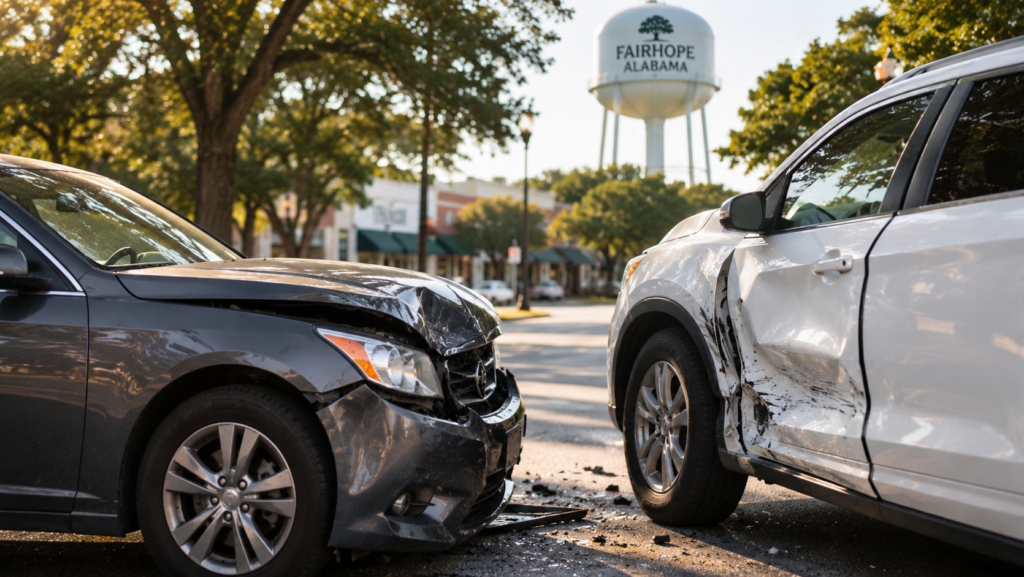
$575,000
Rear-End Collision Settlement in Fairhope
After a serious rear-end crash led to two surgeries and a disputed insurance coverage issue, Caldwell Wenzel and Asthana Personal Injury Lawyers helped secure a $575,000 settlement for the injured client.
Read case study
$177,127.58
Settlement After a Fairhope Left-Turn Collision
A left-turn crash caused a concussion, spine injuries, and a torn meniscus. The case ultimately recovered $177,127.58 through the at-fault driver’s coverage and the client’s own underinsured motorist policy.
Read case studyTalk to Caldwell Wenzel and Asthana Personal Injury Lawyers About Your Case
If you were injured because of a dangerous condition on someone else’s property, our premises liability attorneys in Alabama can review what happened and explain your legal options. Your initial consultation is free.